
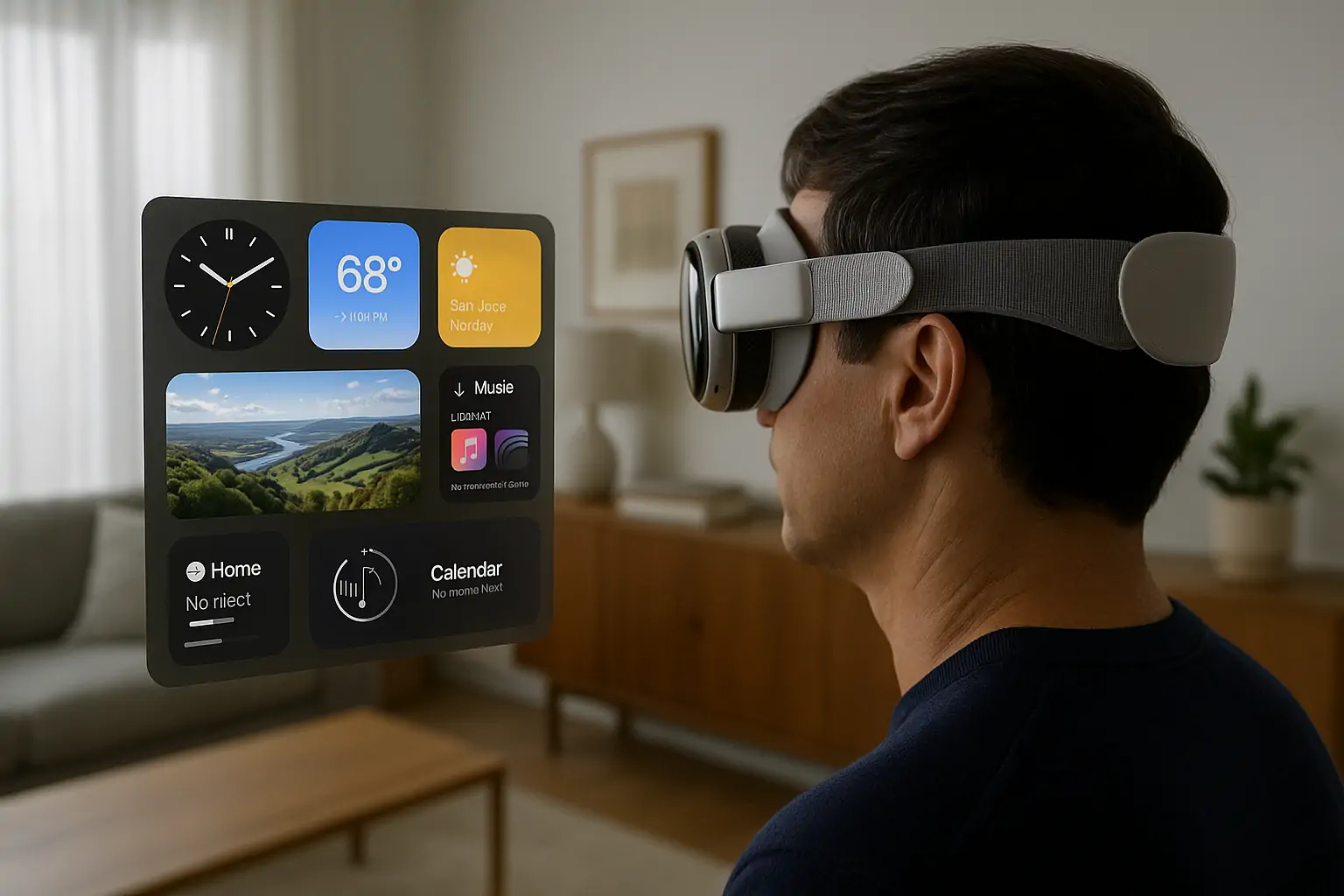
Apple visionOS 26 update takes everything users love about Apple Vision Pro and deepens the experience with spatial interactions that feel more alive, expressive, and integrated into their surroundings. From enhanced Personas to AI-generated spatial photos, this release builds on the device’s promise as the future of personal computing — not just to view content, but to inhabit it.
Users can now decorate their environment with spatial widgets that remain anchored in place, explore memories with incredible depth through Spatial Scenes, and engage with others in shared immersive experiences. Everything feels more connected — whether it’s FaceTime calls that merge physical and digital presence, or Safari articles that unfold into 3D space.
Spatial Widgets Reimagine the Home View
With visionOS 26, widgets are transformed into persistent, immersive experiences. They are no longer confined to a panel — they live in your space, reappearing exactly where you left them each time you put on Apple Vision Pro. These new spatial widgets are fully customizable, from size and depth to color accents, giving users a powerful way to integrate glanceable information directly into their surroundings.
Whether it’s a weather panel by your kitchen window, a floating clock by your bedside, or a music control widget beside your desk, the possibilities are as creative as they are functional. Users can also pin stunning panoramas, personal photo moments, and app shortcuts into their environment with ease.
The new Widgets app acts as a spatial launcher, helping users discover compatible widgets not only from visionOS apps but also from iOS and iPadOS via WidgetKit. Developers can tailor their widgets for spatial presentation, adding a new layer of utility and delight. This turns the Vision Pro experience into a deeply personal and context-aware interface — one that blends lifestyle and productivity without breaking immersion.
Enhanced Shared Spatial Experiences and Next-Gen Personas
visionOS 26 builds on the immersive power of Apple Vision Pro by deepening how users connect and collaborate in spatial environments. One of the most anticipated enhancements is the ability to share spatial experiences with other Vision Pro users in the same physical space. Whether watching a blockbuster in 3D, co-playing a spatial game, or working together in a design app, users can now engage in dynamic, shared environments without being in separate calls or mirrored sessions.
These new capabilities transform Apple Vision Pro into a more social device. You can seamlessly blend local and remote interactions — FaceTime participants from around the world can be added to shared activities, keeping teams or families connected no matter where they are. For professionals, this means brainstorming sessions or collaborative 3D modeling in apps like Dassault Systèmes’ 3DLive can happen naturally, across distance and across devices.
Alongside these shared experiences, Personas receive their biggest update since launch. The photorealistic avatars used in Vision Pro are now rendered with much greater fidelity, thanks to enhanced machine learning and volumetric capture. Users will notice more accurate hair textures, refined facial details like eyelashes and skin tone, and even support for profile views — all of which contribute to a more expressive, lifelike presence.
Apple has also refined the setup process, allowing users to preview their Persona in different spatial contexts and customize it with greater control, including over 1,000 eyewear variations. This not only improves visual realism but also brings comfort and identity to how users represent themselves in immersive environments.
Spatial Scenes and AI-Enhanced Photography
visionOS 26 brings photos to life in a profoundly new way with the introduction of spatial scenes — immersive, multidimensional renderings of user photos that go beyond the flat frame. Powered by advanced generative AI and computational depth, spatial scenes allow users to lean in, look around, and experience memories with striking realism and perspective.
Rather than simply presenting stereoscopic images, Apple’s new approach builds an entire depth-aware environment around key photo content. This means your favorite images — a family dinner, a scenic hike, or a child’s birthday party — feel like frozen moments you can step into. Users can explore these scenes in the Photos app, in Safari through supported content, or inside the Spatial Gallery app where curated visuals shine in full immersive depth.
Apple has also opened up the Spatial Scene API for developers, enabling apps to render custom spatial scenes using this new generative pipeline. Early adopters like Zillow are already enhancing virtual home tours with the added dimensionality spatial scenes bring — offering a much richer sense of layout and scale.
Whether you’re reminiscing personal memories or exploring professionally designed immersive content, spatial scenes in visionOS 26 transform photography into an experience. The fusion of depth mapping, AI inference, and user curation allows Apple Vision Pro to cross the boundary between viewer and environment.
Immersive Web and Media Playback
Apple’s updates to Safari and media handling in visionOS 26 dramatically expand what’s possible for content interaction. Users can now enable a spatial browsing mode in Safari that removes distractions and lifts article content into layered 3D space. Web developers can embed 3D models directly into pages — making it possible to inspect a product, spin it around, and view it in-room without leaving the browser.
visionOS 26 also supports native playback of immersive video formats, including 180-degree, 360-degree, and wide field-of-view content from partners like Insta360, GoPro, and Canon. These formats allow action and lifestyle content to come alive in stunning clarity and perspective, with playback designed specifically for the Vision Pro’s spatial display system.
Gamers get a serious upgrade as well. The addition of PlayStation VR2 Sense controller support means developers can build games that take advantage of high-precision motion tracking, finger touch detection, and responsive haptics. This opens the door for a new generation of spatial gaming experiences — more tactile, responsive, and visually compelling than ever.
Enterprise Capabilities Get Smarter and More Secure
Organizations around the world are already leveraging Apple Vision Pro for training, sales, product demos, and more — and visionOS 26 strengthens those capabilities with powerful new tools. A new team device sharing feature allows enterprises to set up pools of devices with secure user profiles. Each user’s vision settings, accessibility preferences, and eye-hand calibration can be securely saved to their iPhone and transferred as needed.
New hardware integrations expand what’s possible in enterprise workflows. Logitech’s Muse spatial controller — supported natively in visionOS 26 — gives professionals even more precise input control for collaboration in 3D apps like Spatial Analogue or CAD-based workflows.
Security gets an enterprise-grade boost as well. With the new Protected Content API, developers can restrict access to sensitive materials like medical records or internal designs, enforcing visual-only access with no screenshots, sharing, or copying allowed.
Tools for Developers and visionOS Creators
Developers are at the heart of visionOS, and Apple continues to expand their creative and technical toolkit. The visionOS 26 SDK introduces updated APIs for spatial layout, app-to-app transitions, and visual styling — helping developers build more seamless and performant apps for spatial computing.
Support for WidgetKit and the Spatial Scene API encourages broader widget integration and lifelike visuals. WebKit enhancements bring new JavaScript behaviors and visual fidelity to Safari-based spatial apps. Developers can also begin testing their apps with PlayStation VR2 Sense controller input, unlocking gaming experiences with precision interactivity.
These updates are already available in the visionOS 26 developer beta (build 1V902), and a public beta will roll out via the Apple Beta Software Program next month. The official release is expected this fall alongside iOS 26, iPadOS 26, and macOS Tahoe.
A New Chapter in Spatial Computing with visionOS 26
visionOS 26 marks a defining moment in the evolution of Apple Vision Pro. By blending personalization, expressivity, and utility in entirely spatial ways, Apple continues to push the boundaries of what immersive computing looks like — and feels like. From intelligent spatial widgets that live where you work and play, to lifelike Personas and collaborative experiences that span both distance and dimension, this update reinforces Vision Pro’s role as Apple’s most ambitious platform yet.
For users, it’s an invitation to experience the future — one anchored in their surroundings, enhanced by context, and powered by Apple’s spatial design. For developers and enterprises, it’s a powerful new foundation to build next-generation apps, workflows, and shared environments. visionOS 26 isn’t just an update. It’s a new operating language for how we see, interact with, and belong in digital space.
